


You know how every conversation about Artificial Intelligence seems to end with a worry about job losses? It’s a valid concern, but in Malaysia, the data is telling a different, more optimistic story.
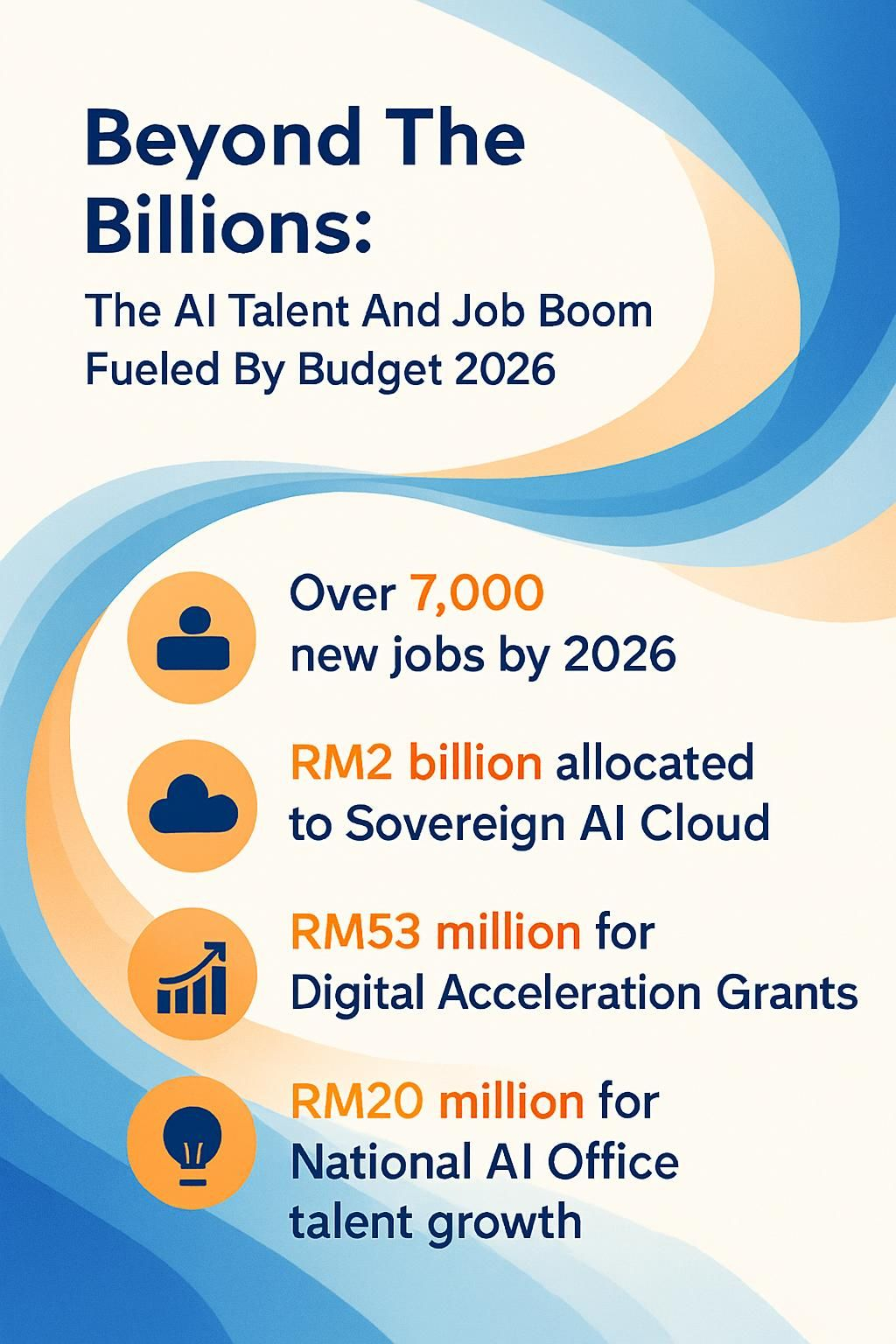
Thanks to a focused strategy in the Budget 2026, the country is on track to create over 7,000 new jobs in the AI sector, shifting the narrative from displacement to opportunity.
According to a 2024 report from JobStreet, 79% of Malaysian professionals already anticipate their roles will change due to AI, showing a readiness to adapt.
This isn’t just about big numbers and government spending; it’s about a real workforce shift, and one that is creating tangible demand for new skills and roles across the economy.
In this breakdown, I’ll walk you through where these new jobs are emerging, the specific skills that companies are desperate for, and how you can use government-backed incentives to build your career in this space.
New roles are opening up rapidly across Malaysia’s tech landscape, from cloud computing to specialised AI research. Fields like machine learning, automation, and digital business transformation are calling for skilled professionals, creating a tangible energy in the job market.
The Malaysian Communications and Multimedia Commission (MCMC) is investing RM2 billion to develop Malaysia’s Sovereign AI Cloud, a project designed to ensure the nation’s data remains secure and within its borders. This initiative is a major catalyst for job creation, sparking demand for a wide range of technical experts.
Direct roles emerging from this project include:
These professionals are essential for designing robust systems and managing the day-to-day operations of large-scale data centres. As global tech giants like Microsoft and Google invest billions in new data centres, the need for these skills is set to intensify. The MCMC is also establishing an AI Transformation Centre with Multimedia University and a Centre of Excellence in Ethics, creating further demand for specialists in AI policy and regulatory development.
The goal of this home-grown cloud is to achieve full data sovereignty. This reduces reliance on foreign hosting providers and ensures that sensitive citizen and government data is managed domestically, a critical step for both public agencies and private businesses.

In Malaysia’s booming semiconductor manufacturing sector, roles like Machine Learning Scientists and Robotics Engineers have become central to innovation. These experts drive research and development in crucial areas like chip design and quality control.
The government is backing this push with significant funding. The National Semiconductor Strategy (NSS) aims to secure RM500 billion in investments and train 60,000 skilled local talents by 2030. As of March 2025, over RM63 billion has already been secured. Specific allocations include RM500 million in loans from Bank Pembangunan Malaysia and another RM180 million from the NIMP Industrial Development Fund to integrate AI into factory floors.
Most of these high-value R&D jobs are concentrated in Malaysia’s primary tech hubs: Penang, Kulim, and the Klang Valley. Here, Computer Vision Engineers use smart cameras to inspect chip quality, while AI Research Scientists work on next-generation industrial solutions. Recent updates to the NSS focus on growing local champions, with 13 firms like Inari, ViTrox, and OppStar identified as rising national players. This complements major foreign investments, such as Intel’s US$7 billion facility in Penang.
This focus on homegrown talent is part of a larger “Made by Malaysia” vision, which aims to transition the country from a user of technology to a creator of it.
The digital transformation of small and medium enterprises (SMEs) is creating a huge wave of job opportunities. Roles like AI Specialists, Data Analysts, and Digital Transformation Officers are in high demand as local businesses adopt new technologies.
To fuel this transition, the government has introduced the Malaysia Digital Acceleration Grant – Artificial Intelligence (MDAG-AI). In July 2025, MDEC launched grants totalling RM2.9 million to help high-potential local companies commercialise their AI solutions. These SME-focused roles represent the largest portion of the 7,000+ new jobs being created, extending opportunities far beyond the traditional tech centres.
Tax incentives are also accelerating this shift. SMEs can claim an additional 50% tax deduction on fees for recognised AI and cybersecurity training programs available through the MyMahir portal. This government support, managed by TalentCorp and MyDigital, empowers businesses to upskill their teams affordably, building a broader and more resilient digital workforce across the country.
Companies are actively seeking professionals who can build, manage, and ethically deploy AI solutions to solve real-world problems. Developing skills in areas like machine learning operations and AI governance can unlock doors to the most promising new roles in Malaysia’s technology sector.
Machine Learning Operations (MLOps) and AI Infrastructure Engineering are at the top of Malaysia’s AI skills wishlist. As companies move AI models from research into production, they need engineers who can build and manage large-scale systems. The RM2 billion Sovereign Cloud project, in particular, is a massive driver for these roles.
MLOps experts are responsible for the entire lifecycle of a machine learning model, ensuring it runs smoothly and reliably. This goes beyond just writing code; it involves deploying models on cloud platforms and using containerisation tools such as Docker and Kubernetes for scalability.
Success in digital transformation sits on strong foundations built by skilled engineers. Without MLOps specialists ensuring reliable deployment, all that investment risks being wasted.
– Dr Ramesh Subramaniam, National AI Office
A key challenge they solve is “model drift,” where an AI’s performance degrades over time as real-world data changes. MLOps engineers implement monitoring systems to detect and retrain models automatically. Given the high demand, salary survey data from 2025 shows that experienced AI engineers in Malaysia can earn an average salary of over RM157,000 annually, with senior roles commanding up to RM196,255.
The demand for data analytics professionals in Malaysia is becoming highly specialised. Employers are no longer looking for generalists; they want experts who understand the unique data challenges of their specific industry.
For example:
This shift is heavily influenced by the National AI Roadmap, which encourages applied research in key economic sectors. As a result, R&D hubs in Penang, Kulim, and the Klang Valley are actively hiring specialists who can turn raw data into actionable business intelligence using tools like Python, Power BI, and Tableau.

With the rise of AI, jobs in Governance, Risk, and Compliance (GRC) are becoming critical. The launch of the National Guidelines on AI Governance and Ethics (AIGE) in September 2024 has created a formal framework for building safe and transparent AI systems.
GRC professionals ensure that companies adhere to these guidelines and comply with laws like the Personal Data Protection Act (PDPA). Their work is crucial for building public trust and mitigating risks like data privacy breaches. While the AIGE is currently a voluntary framework, Digital Minister Gobind Singh Deo confirmed in October 2025 that a new law to regulate AI is being drafted, signalling that these skills will soon be legally mandated.
Businesses across Southeast Asia are racing to create AI that can understand and interact in local languages, creating a huge demand for Natural Language Processing (NLP) specialists. The focus is on developing AI tools that can grasp the nuances of languages like Bahasa Melayu and even “Manglish,” which often involves code-switching between languages.
Startups and tech firms are particularly interested in experts who can fine-tune Large Language Models (LLMs) for the ASEAN market. This allows digital services, from chatbots to customer support platforms, to feel more natural and intuitive for local users. Government initiatives like the Malaysia Digital Acceleration Grant (MDAG-AI) and tax deductions for NLP training are making it easier for both companies and individuals to build these highly sought-after skills.
AI Product Managers are the crucial link between technical AI teams and business objectives. They are responsible for identifying real-world customer problems that can be solved with AI and then guiding the development of those solutions from concept to launch.
This role requires a unique blend of skills: a deep understanding of AI capabilities, strong business acumen, and expertise in user experience design. As Malaysia’s “Made by Malaysia” AI ecosystem expands, the demand for product managers who can create commercially viable AI products is soaring. Recognising this need, the National AI Office is working with universities to develop talent in this area, and platforms like MyMahir now list certified courses in product management and market analysis.
Thanks to the initiatives in Budget 2026 and the support from Malaysia’s National AI Office, upskilling for a career in AI has never been more accessible. Resources like MyMahir and targeted tax incentives are available to help you prepare for the future of work.
A key incentive from Budget 2026 is the additional 50% tax deduction for companies that invest in AI and cybersecurity training for their employees. You can approach your manager with a specific, high-quality course from the MyMahir portal that aligns with your company’s goals.
Frame the request as a direct investment in the company’s productivity. By taking a course in MLOps, for example, you could help the company deploy AI solutions more efficiently. This tax relief significantly lowers the cost for your employer, making it a much easier “yes.” This initiative is especially targeted at micro, small, and medium enterprises to boost their digital capabilities.
The National AI Office (NAIO) received RM20 million in Budget 2026 to cultivate the next generation of AI talent. If you’re a student, now is the perfect time to align your studies with the skills the nation is investing in: machine learning, AI governance, and product management.
Top universities like Universiti Malaya and Universiti Teknologi Malaysia are strengthening their AI faculties in collaboration with NAIO. Look for opportunities to participate in government-endorsed programmes like Microsoft’s AI for Malaysia’s Future (AIForMYFuture), which aims to train 800,000 Malaysians and has already reached over 400,000 as of May 2025. Keep an eye on announcements from NAIO and MDEC for scholarships that can help you step into a high-demand job right after graduation.
Whether you’re an employee, a student, or a job seeker, MyMahir is your central resource for finding high-quality, government-recognised training courses. Managed by TalentCorp, the platform lists certified programs in AI and data analytics that meet national skill standards.
The MyMahir portal is straightforward. You can search for specific skills like “Machine Learning” to find courses from accredited providers. A great starting point for anyone is the free, self-paced AI untuk Rakyat programme, which provides foundational awareness and awards digital badges upon completion. Crucially, only paid courses listed on MyMahir are eligible for the 50% training tax deduction and other government grants.
Malaysia is making a significant financial commitment to Artificial Intelligence, but the real investment is in its people. The AI talent and job boom fueled by Budget 2026 is creating a clear path for workforce development in data science, AI engineering, and policy.
This transformation is opening up thousands of new roles for those who are prepared to learn and adapt.
By using government incentives and choosing a recognised course through MyMahir, you can secure your position in this growing field. The most important step is to start now. Preparing for the future jobs in an economy built on technology gives you the advantage. This opportunity is available to everyone, and the time to begin is today.
Budget 2026 allocates significant funding to key initiatives that directly create demand for AI skills. This includes RM2 billion for a Sovereign AI Cloud, RM20 million to the National AI Office (NAIO) for talent development, and a 50% tax deduction for SMEs that invest in AI training for staff.
Beyond general AI engineers, highly specific roles are in demand. These include MLOps Engineers to manage AI systems, Cloud Architects for the Sovereign Cloud project, AI GRC Specialists to ensure ethical compliance, and NLP specialists to develop AI for local languages. These roles are concentrated in tech hubs like Kuala Lumpur, Penang, and Kulim.
That’s a common myth. While technical roles are important, positions like AI Ethicist, AI Product Manager, and AI Governance Specialist are growing rapidly as companies and regulators prioritise responsible innovation. These roles require strong business and strategic thinking skills, not just coding ability.
Start with accessible programmes like the free ‘AI untuk Rakyat’ course on the MyMahir portal to build foundational knowledge. For deeper skills, explore government-funded Skills Bootcamps or certified courses on MyMahir that are eligible for tax deductions. Also, consider joining initiatives like Microsoft’s AIForMYFuture, which offers free, sponsored training.
